
The Throughput Mastery Framework
This blog was originally published in the Throughput Newsletter on 1/7/26
Six months ago, I sent an email about a productivity model I'd developed called the Pyramid of Productivity. I got better feedback than expected, and have used it to great success with some Throughput Mastery members. But the pyramid was always lacking. It was never the full, here's-how-to-run-a-business framework, that I was really trying to create. I'm not sure exactly what was going through my head when I finalized that pyramid, but it's likely that I couldn't quite make the pieces fit together and published a B+ version of what I really wanted. It happens, I guess.
Well, I've fit the pieces together.
The real weakness of the pyramid was that it addressed only a small portion of what a company needs (productivity, or what I've called "Momentum" in the new model), and if the other pieces aren't in place, you'll never be productive. So even if the pyramid was accurate, it wasn't always useful if the company wasn't operating well in other areas.
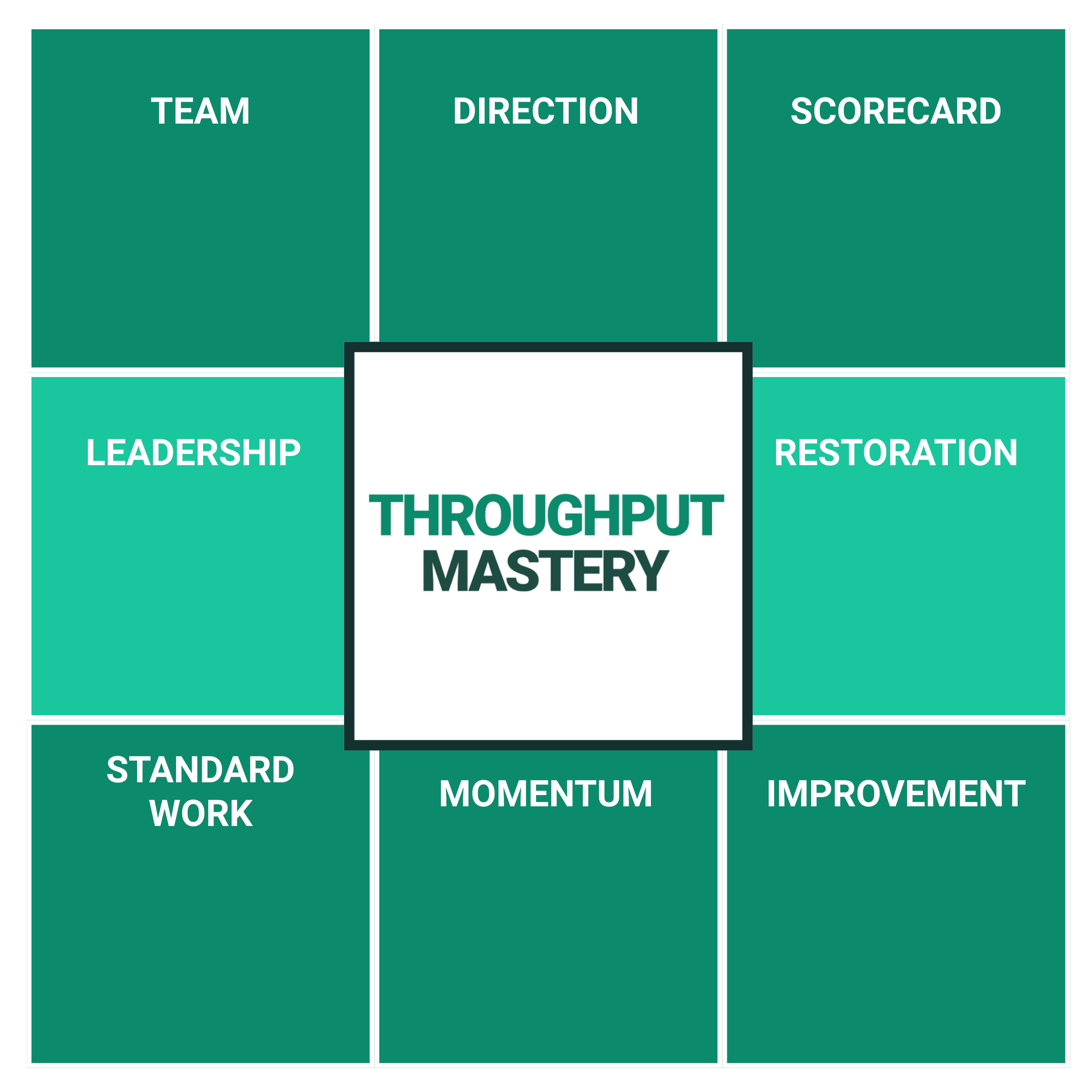
Enter the Throughput Mastery Framework. A tool to help your entire business run as a professional business should. (Yes, there are such things as unprofessional businesses. I've seen a few of them.) In baseball, coaches and commentators often refer to a hitter as a "professional hitter" if he does the right things, follows a good process, sticks to the fundamentals, keeps things simple, and gets results other hitters wouldn't. It's never based on athleticism or raw skill; it's based on mindset, approach, and discipline. Miguel Cabrera, Gleyber Torres, Matt Stairs, Chipper Jones have all been described as professional hitters. These players have amazing natural talent (chiefly, hand-eye coordination), but even if they didn't, they'd grind out at-bats and get hits. Now that I think about it, this is the perfect analogy for a professional business.
Anywho, today I want to introduce the Throughput Mastery Framework and talk a little bit about one of the squares. Without further ado or talk about baseball, here it is:
These 8 squares (6 dark green = company-wide, 2 light green = personal) serve as a guiding framework for any business of any size in any industry. Of course, my focus is on manufacturing, but good business is good business no matter what industry you're in. If you implement these 8 principles, and the sub-principles and tactics that fall beneath them, you're probably going to have more success than you would without these or some framework. There are no guarantees in life, but this is a high likelihood.
Unlike a game of Tic-Tac-Toe, in this grid the best block to start in is top-middle: DIRECTION. Where is your company going, where is it now, and how will you get there? This includes your vision, mission, core values, 3-year goals, 1-year goals, etc. It also includes which markets you'll play in and which markets you'll ignore. This is the charter document for your company. All decisions can and should be filtered through at least one piece of your DIRECTION. Maybe you're considering a new market; your vision and mission will be helpful to see if it makes sense. Maybe you've got some internal conflict; time to reference your core values and see if they can help you determine the future course of action.
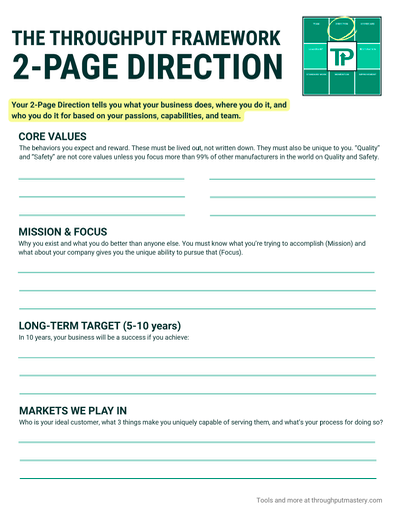
There are many different principles and tactics that apply to the DIRECTION section. I believe the most important is that it is "Stated loudly, clearly, and often." Your team should be a little bit annoyed by how much you talk about it. Your team should make jokes about how you're like a broken record. Your team should be able to recite your DIRECTION if you went to their house at 3 am, woke them up, and asked them to do so. (Don't do this.)
Today, I've got the first piece of the Throughput Mastery Framework for you: the 2-page DIRECTION Planner. It takes you from 10,000 feet to quarterly goals in two pages. It's like the Pyramid of Productivity, but better, and it's just the beginning. (!)
I'd love for you to download it, read through it and either 1) complete it and use it, or 2) determine which parts of this document may be missing from your planning process, and supplement your existing process using the DIRECTION Planner.
If you do either of those, tell me about it!